Two previously uncatalogued Broucke-region orbits
We found two primitive, collisionless, equal-mass, zero-angular-momentum periodic orbits with strong numerical evidence of planar spectral stability. Both are absent from the five numerical catalogues and Rose’s 363-orbit catalogue checked here. They extend known Broucke-region dynamics; this note does not claim a new progenitor family, mathematical proof of existence, nonlinear KAM stability, or worldwide priority over unpublished work.
In the atlas: BH-1113 BH-1252 BH-818 (all three re-converged in double-double arithmetic by the atlas’s own tool, closure below 10⁻²⁰, linearly stable).
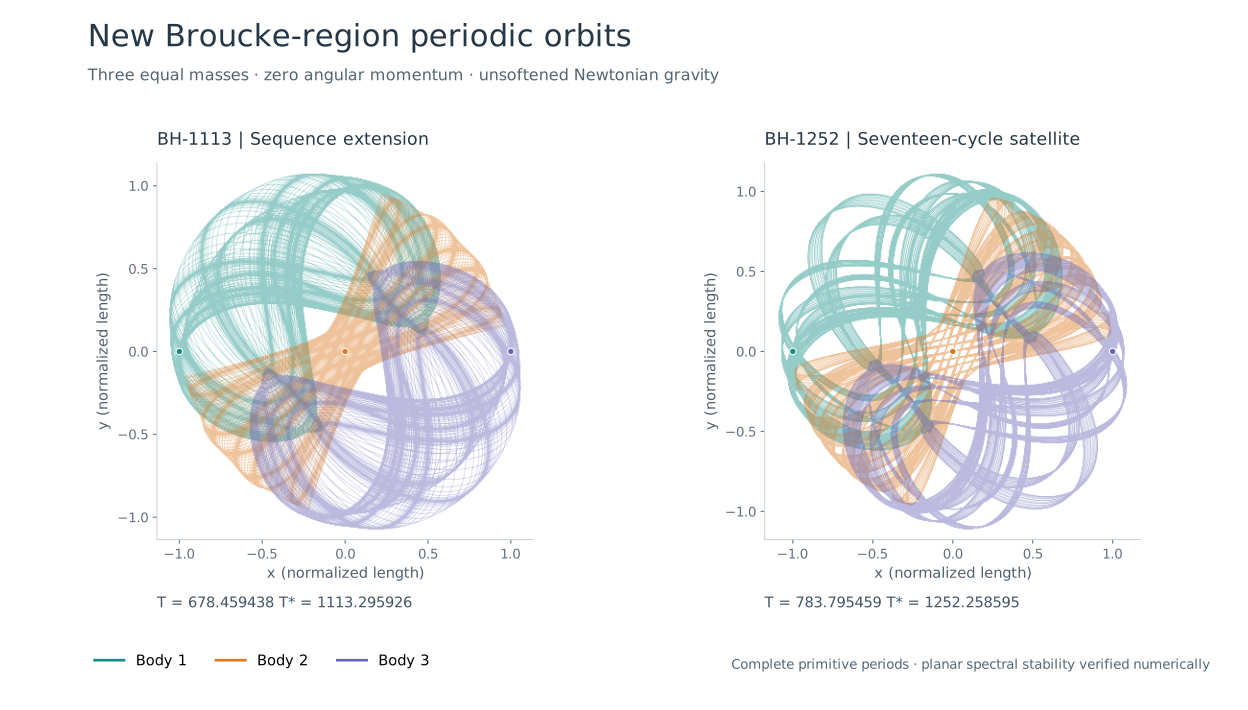
The reproducible initial conditions
Use unsoftened Newtonian gravity with G = 1 and m₁ = m₂ = m₃ = 1. Positions at t = 0 are q₁ = (−1, 0), q₂ = (0, 0), q₃ = (1, 0). Velocities are v₁ = v₃ = (u, v), v₂ = (−2u, −2v). The total momentum, centre of mass and angular momentum are exactly zero by this algebraic construction.
| Quantity | BH-1113 | BH-1252 |
|---|---|---|
| u | 0.186401033451143894574657354556003 | 0.229637004228965643016540067733666 |
| v | 0.578664809464713085943982936861232 | 0.570128458830328541750616526612096 |
| Full inertial period T | 678.459437705175767377176930656423 | 783.795458886605442229571246432102 |
| Energy E | −1.39120507904653850615 | −1.36666116016150116524 |
| T* = T·|E|^(3/2) | 1113.29592619961538088147 | 1252.25859500068644019629 |
| Collinear passages per primitive period | 726 | 816 |
| Smallest numerical pair separation | about 0.000579886 | about 0.025653415 |
These are normalised units, not a specific astronomical system. Newtonian scaling changes lengths, times and velocities while preserving T*. Complete decimal strings, velocities and numerical diagnostics are in the initial-conditions file. Preserve these strings with arbitrary precision when verifying the results; ordinary floating-point precision is adequate for an animation but cannot reproduce the quoted tiny closure errors.
Verification and stability
The search used canonical Jacobi coordinates, compiled Taylor integration, analytic variational equations and Newton shooting. Verification used independently written full Cartesian equations and sensitivities, a different canonical centre-of-mass reduction, and an explicit quotient removing the neutral flow/energy and rotation/angular-momentum directions. Both high-precision implementations use heyoka’s Taylor/MPFR engine. A separate SciPy DOP853 implementation supplied the lower-precision trajectory, encounter and recurrence checks.
| Verification | BH-1113 | BH-1252 |
|---|---|---|
| Independent Cartesian arithmetic | 160 bits | 160 bits |
| Full-period Cartesian state return, infinity norm | 4.1238e-37 | 1.8591e-37 |
| Reduced symplectic defect, infinity norm | 1.2415e-32 | 2.0267e-35 |
| Floquet frequency 1, cycles per full period | 0.08211054416856 | 0.00018034467814 |
| Floquet frequency 2, cycles per full period | 0.31152313010966 | 0.31498832135286 |
The four nontrivial planar multipliers are two distinct complex-conjugate pairs on the unit circle. Rounded values are:
- BH-1113: −0.377005621342075 ± 0.926210970285105i, and 0.869841311415958 ± 0.493331625738880i.
- BH-1252: −0.397080545553386 ± 0.917783765569551i, and 0.999999357998036 ± 0.001133138789419i.
The full centre-of-mass-reduced monodromy also has four neutral multipliers at +1. Tiny numerical splitting of those neutral multipliers is not classified as a physical instability. The independent four-dimensional quotient and reciprocal stability indices supply the decisive classification. For BH-1252 the weak pair is close to +1, but its separation is resolved by many orders of magnitude at the working precision.
Initial conditions and spectra agree across the 128-bit canonical and 160-bit Cartesian calculations. The independent full-period state propagation does not force closure by reflecting an already computed arc. The half-period monodromy construction does use the exact Euler time reverser, M = F·Φ_half⁻¹·F·Φ_half, with both endpoints verified in Fix(F).
For BH-1113, three additional double-precision experiments followed 1,000 full periods each: the nominal initial point and two small perturbations of a Jacobi shape coordinate, of sizes 1e-8 and 1e-7, adjusted to preserve initial L = 0. All 1,000 sampled returns stayed near the orbit; the largest sampled barycentric radius was below 1.000010 and sampled energy drift below 1.4e-10. These are finite, stroboscopic experiments, not a nonlinear stability theorem.
No gravitational softening was used. Pair-distance minima were located by solving for zero radial relative velocity on an independently integrated dense trajectory. The quoted minimum distances are numerical estimates, not interval-certified lower bounds. BH-1252 has substantially more clearance and is the easier of the two to animate or experiment with in ordinary precision.
Why these are not repeated old orbits
An initial condition in a new coordinate chart is insufficient evidence of a new orbit. We therefore checked all collinear passages over each period, jointly comparing positions and velocities under body relabelling and proper rotation. We also tested the period divisors implied by the syzygy counts. Both orbits return at half a period only after an orientation-reversing reflection; that does not make the absolute period smaller.
- BH-1113: the smallest earlier absolute state mismatch was about 0.001925. After optimising proper rotation and equal-mass relabelling, the smallest normalised mismatch was about 0.001136. These are much larger than the independent trajectory’s numerical errors.
- BH-1252: the corresponding mismatches were about 0.009594 and 0.001320. At T/17, a high-precision full-state integration differs from the initial state by 0.1467324954647 in the maximum coordinate norm.
BH-1252 has the published B1 / Sofia global-ID 9 syzygy word repeated exactly 17 times, after cyclic shift and relabelling. Its primitive dynamical period is nevertheless the full T. Its T* differs from 17 times B1’s T* by only about 3.9157e-7, so a loose period-only deduplication would mistakenly discard it. The full-state recurrence checks exclude a 17-fold traversal, a rescaling, and a rephasing of the parent.
The complete event times, middle-body words, best-fit transformations and return residuals are included in the reproduction archive. The exact word is an itinerary identifier, not by itself a proof of orbit identity.
Catalogue and literature comparison
The comparison covered the following numerical snapshots. Counts are records/starts, and can include multiple representations of one orbit.
| Catalogue | Records checked | Largest catalogue T* |
|---|---|---|
| Hristov–Hristova–Tanikawa stable catalogue, 2025 preprint / July 2026 article | 971 | 799.7677 |
| Li–Liao equal-mass catalogue, 2017 | 695 | 622.874, rounded table |
| Sofia figure-eight satellites | 821 | 572.6713 |
| Sofia trivial choreographies | 462 | 1671.9063 |
| Historical Belgrade/Hudomal initial conditions | 206 | approximately 274.0274 |
| Rose thesis bestiary, including relative orbits | 363 | 254.4562 in its reduced-period convention |
Neither primary orbit has an invariant-period match in these catalogues. For BH-1113 the closest direct period differs by about 3.91774; for BH-1252 by about 4.06606. Potential integer repetitions of old absolute and relative orbits were also considered. The special near-match of BH-1252 to 17 × B1 is resolved by its primitive state-return evidence, as described above.
The latest stable catalogue’s T* < 800 limit was a useful search boundary, but exceeding it alone does not establish novelty: the earlier choreography catalogue extends beyond 1,600. Catalogue absence also cannot exclude an unindexed or unpublished discovery. The defensible claim is numerically verified, previously uncatalogued in the named sources checked on 8 September 2026. Contact with authors, independent outside reproduction, and a public preprint would be the next steps toward a research-priority claim; no messages or submissions were sent.
Primary sources: latest stable catalogue and data, open 2025 preprint, 2026 article, Li–Liao authors’ data repository, 821 satellites, 462 choreographies, historical initial conditions, and stability/topology review and tables. Rose’s thesis and appendix were parsed in full for catalogue metadata. Download hashes and the longer source audit are retained in the archive.
How the search found them
BH-1113 — extrapolating an orderly sequence. We fitted a small sequence of existing stable Broucke starts, B15, B33, B80 and B98 (global IDs 150, 269, 660, 921), with T* ≈ 340.446871, 450.853826, 671.667833, 782.074853. Their spacing suggests selected additional laps with an increment near 110.407. Extrapolating u and v against inverse T*, followed by Newton correction of the Euler half-twist conditions, produced unstable extensions at T* ≈ 892.48 and 1002.89, then the elliptic extension at 1113.295926. Stability was checked after correction rather than inferred from the sequence.
BH-1252 — a symmetry-resolved resonance and deflation. The B1 half-map mode near 0.355001606 was targeted at 6/17. General reflection-shift shooting produced a near-periodic lead but had a nearly singular phase direction, so that lead was not counted as a discovery. Projection back to a reversible Euler start followed by ordinary Newton initially returned the repeated parent. Deflation exposed a distinct elliptic root and a nearby hyperbolic root. The elliptic root was then corrected in arbitrary precision and independently verified. This supports a useful resonance-pair search mechanism, without constituting a proved bifurcation theorem or a new off-Euler-slice family.
The proposed seven-cycle around B2 was checked against the literature first and recognised as a rediscovery risk: published B86/global 743 already has B2’s word repeated seven times. The successful search therefore concentrated elsewhere. Targeted continuation and resonance selection were substantially more useful here than the trial random perturbations.
Additional result and remaining research
An additional equal-mass L = 0 extension, provisionally BH-818, was corrected and independently found elliptic at 128 bits: u ≈ 0.14440812574526536215, v ≈ 0.58264206570808301571, T ≈ 484.18473153758528338, T* ≈ 818.45629702825002666. Its frequencies are about 0.20192040671 and 0.00041406057. It has extremely close encounters (about 6.3e-6), and the ordinary-precision trajectory diagnostics are less accurate. Its full high-precision periodicity and stability record is included as an additional result rather than the principal demonstration.
The most valuable next research work would be an outside reproduction of the two primary orbits, a careful continuation study of the elliptic/hyperbolic 17-cycle pair, and nonlinear twist/KAM analysis. Three-dimensional perturbations changing angular momentum and a formal interval-arithmetic existence proof were not part of this completed planar search.
Files and reproduction
- Initial conditions and validation data (JSON, 160-bit decimal strings).
- Complete-trajectory figure (SVG).
- The reproduction archive (49 MB: both implementations, search logs, corrected decimal inputs, catalogue snapshots, recurrence audits, sampled trajectories and environment records, with a README giving the commands to reproduce the high-precision verification on any system with heyoka.py installed) is available on request from info@threebodyorbits.com.