Eight-hour Broucke-like orbit search
The campaign produced 106,415 independently passing numerical orbit records, including 5,205 cases where both inner trajectories have independently verified intersections with the outer body’s curve. The most useful research results are the resonance daughter representatives and their further bifurcations; the much larger rational-angle catalogue samples a known continuous orbit class. These counts are not counts of new fundamental families.
All accepted records preserve zero angular momentum by construction and close as labelled orbits in the fixed inertial frame. The new ring-crossing examples use unequal masses; many retain two equal inner masses. This run has not established a new ring-crossing solution with all three masses equal. Stability below means numerical linear stability against the full set of physical planar perturbations at fixed masses, not a nonlinear, three-dimensional, or interval-arithmetic proof.
In the atlas. Fourteen of the sixteen selected representatives, every one with a period below 400 time units, form the family Broucke-like rosettes; the atlas’s own tool re-converged each in double-double arithmetic (closure below 10⁻²⁴, all linearly stable). The two second-generation representatives with periods of 2,671 and 10,998 are left out: their traces saturate into solid discs. Each atlas orbit is named by its inner and outer winding counts and qualified by its masses.
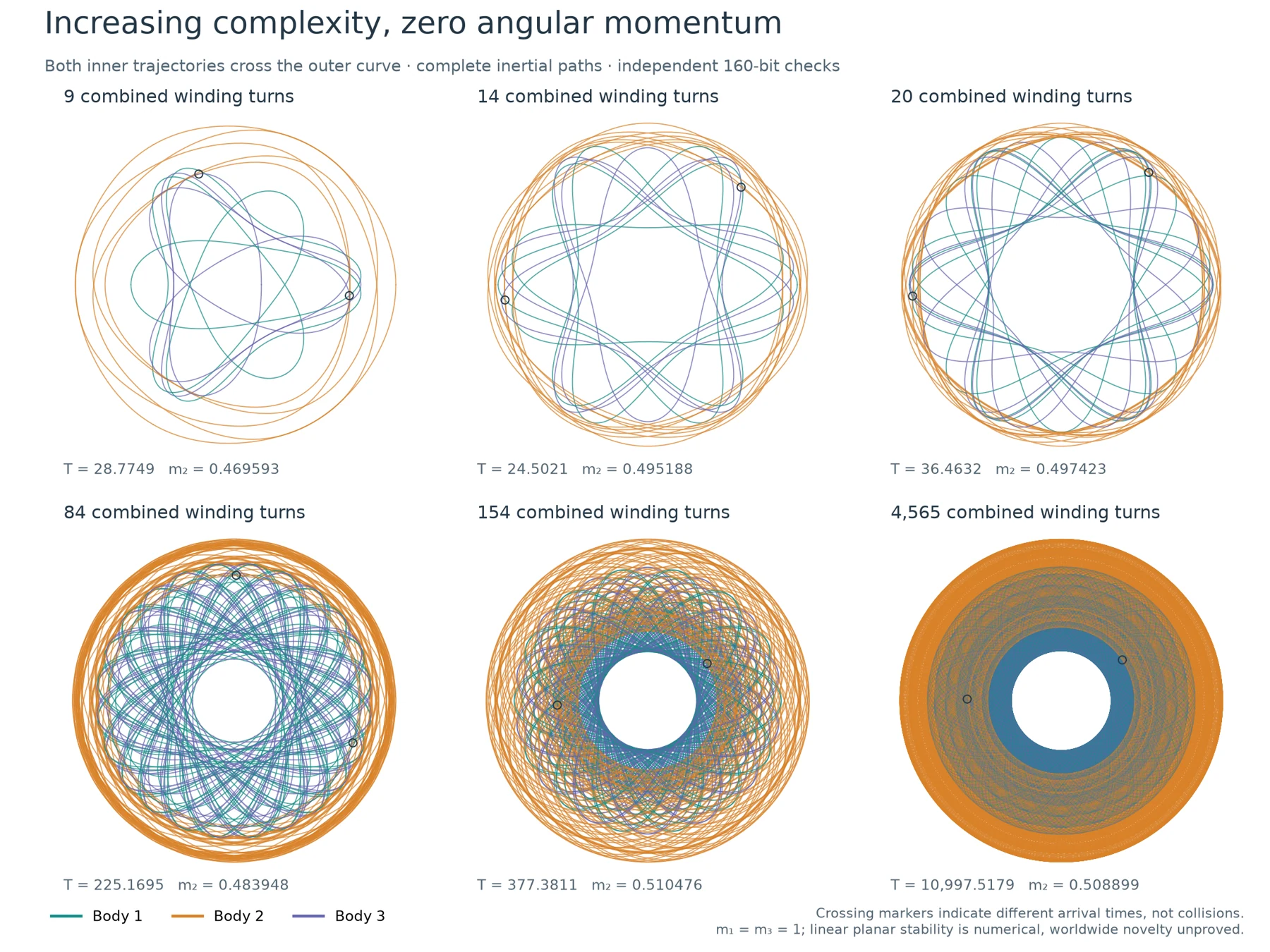
What was found
The independently checked catalogue contains:
| Computational track | Passing records |
|---|---|
| Stable mass-induced period-doubling representatives | 9 |
| Simple retrograde parent, unequal inner masses | 1,897 |
| Mass continuations of resonance daughters | 456 |
| Resonance daughter representatives, equal inner masses | 28 |
| Simple retrograde parent, equal inner masses | 104,025 |
There are 28 selected equal-inner-mass resonance daughter representatives in that table, including 2 second-generation representatives. Different initial phase descriptions and repeated parent orbits were screened out. This is a count of selected orbit representatives, not a classification proving that each starts an unrelated family. Several weak elliptic representatives are retained with separate cautions, including the 1:23, 1:26 and 1:32 cases and a 256-bit follow-up of the weakest 8:29 case described below.
The symmetric catalogue reaches a reduced reconstruction denominator of 731. The largest recorded sum of absolute Jacobi winding turns is 4,565; measured windings and those expected from simple-parent continuation have separate evidence labels. Internal daughter turns are included rather than inferred from the reduced reconstruction fraction. Neither winding sum nor reconstruction denominator is a geometric intersection count or a free-group topological exponent.
Selected crossing orbits
Every row below has direct independent 160-bit integration of its complete labelled absolute period, zero angular momentum, elliptic physical planar multipliers, and independently checked crossings for both inner trajectories. Masses are (1, μ, 1). Periods depend on the chosen units; G = 1 and the initial inner separation is 1.
| Reproduction ID | Combined winding turns | Absolute period T | μ | Normalised full closure error | Atlas |
|---|---|---|---|---|---|
branch_k6_minus_5of9 | 9 | 28.774856 | 0.469593314 | 5.5e-40 | Rosette 4:5 |
branch_res1x14_plus_r9of14 | 14 | 24.502062 | 0.495188272 | 3.3e-39 | Rosette 5:9 |
branch_res1x17_plus_r11of17 | 17 | 34.405531 | 0.496881431 | 8.7e-39 | Rosette 6:11 |
branch_res1x20_minus_r13of20 | 20 | 36.463210 | 0.497423186 | 1.7e-39 | Rosette 7:13 |
branch_k12_minus_19of30 | 30 | 65.880636 | 0.494501278 | 1.5e-38 | Rosette 11:19 |
branch_k6_plus_11of20 | 60 | 112.228856 | 0.474464855 | 2.2e-38 | Rosette 27:33 |
branch_k7_plus_7of12 | 84 | 225.169501 | 0.483947570 | 2.0e-38 | Rosette 35:49 |
branch_k10_plus_13of21 | 105 | 235.995679 | 0.493286015 | 7.1e-38 | Rosette 40:65 |
branch_k9_plus_8of13 | 117 | 310.212977 | 0.485185573 | 5.3e-39 | Rosette 45:72 |
branch_res3x11_plus_r9of14 | 154 | 377.381074 | 0.510475522 | 2.3e-37 | Rosette 55:99 |
branch_res3x11_minus_r139of220 | 220 | 386.356100 | 0.501058686 | 5.1e-38 | Rosette 81:139 |
branch_gen2_q3_plus_r7of99 | 1,089 | 2,670.675183 | 0.510427628 | 4.9e-36 | not shown |
branch_gen2_q5_minus_r4of83 | 4,565 | 10,997.517880 | 0.508899431 | 2.7e-36 | not shown |
The selected unequal-inner-mass examples are also in the selected-orbits file: asym_r7of11_delta0p005000 (Rosette 4:7, masses 1.005, 0.497, 0.995) and asym_r9of14_delta0p025000 (Rosette 5:9, masses 1.025, 0.497, 0.975). In the 1:9 example, the equal inner bodies share a geometric curve with a phase offset; both trajectories crossing does not imply two different geometric inner curves.
A second-generation orbit worth pursuing
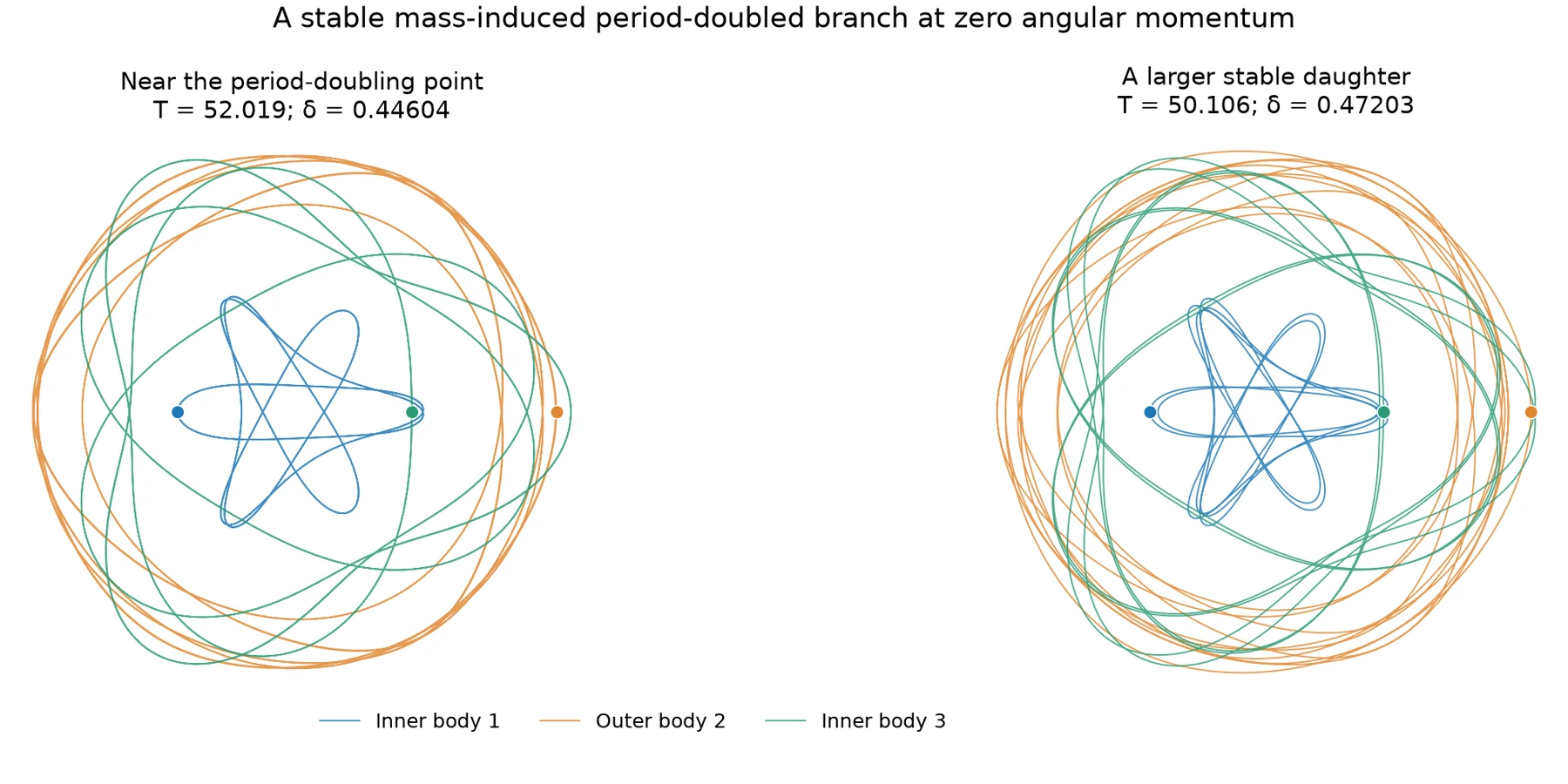
An additional stable period-doubling branch was found by varying the inner masses along the 1:6 daughter. The selected representative asym_branch_k6_minus_mass_flip_amp0p040000 (Rosette 8:10 in the atlas) has masses (1.472027750, 0.369274768, 0.527972250), period 50.105733, and windings (8, −10). It passes independent full-period closure and physical planar ellipticity checks. Its new doubled relative cycle is separated from the parent by explicit non-return tests. Here body 3 crosses the outer curve; a crossing for body 1 has not been established. Separate small-perturbation experiments remained close over 1,000 periods; these are finite-time numerical diagnostics.
A second representative, branch_gen2_q5_minus_r4of83, follows a 1:5 resonance of the 3:11 daughter. Its period is 10,997.517880, masses are (1, 0.508899431328, 1), and independently integrated windings are (1640, −2925): 4,565 combined turns. Their greatest common divisor is 5, but direct integration rejects the possible T/5 return with normalised state mismatch 0.005504. Its full closure error is 2.73e-36. This is therefore numerically a longer labelled orbit, not five traversals of a shorter orbit.
branch_gen2_q3_plus_r7of99 was followed from a 1:3 resonance of a previously found 3:11 daughter. It is not a threefold traversal of that parent’s short relative orbit: an explicit earlier relative-return test has a normalised mismatch about 0.00673. The full labelled orbit has inner/outer Jacobi windings (389, −700), independently obtained by continuous multiprecision angle integration. Their greatest common divisor is 1, which excludes an integer repetition of a shorter labelled orbit, provided the tracked Jacobi vectors remain nonzero as checked numerically.
Its masses are (1, 0.510427627805579, 1) and its period is 2670.675183091556. The independent full-state normalised closure error is 4.869e-36. Its nontrivial full-period planar multiplier pairs are approximately 0.915911 ± 0.401382i and 0.771039 ± 0.636788i, both on the unit circle to the computed accuracy. The sampled/optimised numerical clearance estimate is about 0.2465 in the initial-separation units; it is not a rigorous lower bound.
The initial canonical Jacobi state is (1, 0, b, 0, 0, p, 0, −p/b) with the following retained decimal strings. The definition p_λy = −p/b enforces L = 0 algebraically.
b  = 0.74764154539404319944773016384737749165560515091142755810971
p  = 0.891229954091039954848851748271858813119770746611049290123054
μ  = 0.510427627805579057470753684944126377933823095690935198784983
h  = 40.4647755013872169167925720566909764742556685773931779985739
relative rotation = −2π × 7/33
absolute period = 66h
Representative independently checked path intersections occur at these different times:
| Inner body | Its arrival time | Body 2 arrival time | Crossing angle | Position mismatch |
|---|---|---|---|---|
| 1 | 0.101587584 | 31.967866002 | 14.612° | 1.9e-38 |
| 3 | 0.229820193 | 22.521636523 | 47.614° | 1.1e-39 |
At those times the bodies are not colliding; the proof records retain their simultaneous separations. “Crossing the outer ring” here means intersecting the outer body’s actual trajectory. It does not mean that both inner bodies exceed the largest radius ever attained by the outer body.
Why the search worked
The efficient route was to correct a short time-reversal segment while selecting the middle body’s mass to maintain L = 0 and an exact rational reconstruction angle. Symmetry then constructs long absolute periods without repeatedly solving a long shooting problem. A separate Cartesian implementation checks the segment, the physical stability quotient and, for selected controls, the full-period state directly. Compiled Taylor integration with arbitrary precision, parameter continuation and a persistent validation queue made the campaign feasible on a ten-core laptop.
The +1 multiplier encountered on the simple parent near reconstruction ratio 0.660184 and μ ≈ 0.497795 was identified as a mass fold, not claimed as a new symmetry-breaking branch. Prescribed-amplitude continuation of actual Floquet resonances then produced additional branches. The 3:11 branch reaches μ ≈ 0.51048, beyond the observed simple-parent L = 0 mass maximum, and supplied the parent for second-generation searches. Relative period multiplication and full absolute period multiplication are distinguished: rational reconstruction can change their relationship.
The completed wide unequal-inner-mass screen had 12,564 unique corrected parameter points, of which 8,173 screened elliptic and 1,896 had trajectory crossings. All 1,896 crossing points completed the root 160-bit correction stage. These screening counts overlap later stages and must not be added to the independent catalogue total.
Validation and limits
| Independent evidence tier | Records |
|---|---|
| Multiprecision short-section construction and full physical planar spectrum | 98,474 |
| Also independently integrated relative cycle and refined curve intersections | 7,141 |
| Base checks plus direct complete labelled-period state integration; crossing flags separate | 800 |
These are mutually exclusive bookkeeping categories. Direct full-period integration alone does not establish a curve crossing.
In total, 7,444 records have root-side crossing evidence and 7,444 have independent crossing evidence. Of those, 5,205 and 5,205, respectively, involve both inner trajectories. These are orbit counts with crossing evidence, not counts of distinct intersection locations. Records without a crossing flag have not necessarily been proved non-crossing.
Continuous-angle and divisor-return audits establish numerical labelled primitiveness for 106,415 indexed records. Most bulk audits integrate one independently checked relative cycle, multiply its continuous angle increments by the exact cycle count, and test the possible shorter return times implied by the winding greatest common divisor. They are separate from direct full-period integrations. Their conclusions require the numerically checked Jacobi angle charts to remain nonzero and do not by themselves establish the minimum relative period or resonance-branch ancestry.
The independent equations use canonical Cartesian positions and momenta, a different centre-of-mass pairing and a four-dimensional physical energy/angular-momentum quotient. The stability test includes perturbations that break the search symmetry. Search and validation nevertheless share Heyoka’s integrator, so this is formulation and implementation cross-checking rather than complete software diversity. The calculations are high-precision numerical evidence, not interval-certified existence theorems.
Several higher-mode candidates that looked elliptic at ordinary precision became weakly hyperbolic at 160 bits and were rejected. The retained 8:29 representative has an exceptionally weak mode; a separate 256-bit correction and Cartesian check resolved its stability index below 2 by about 1.0×10⁻²⁸, with full-state closure about 2.0×10⁻⁶⁶. It is the same orbit at higher precision, not an additional discovery, and is excluded from the robust visual showcase.
For two shorter crossing daughters, finite-time perturbation experiments in four transverse directions, at amplitudes 10⁻⁷ and 10⁻⁵, remained close to the reference motion over 1,000 periods. The largest sampled orbit distances were about 1.5×10⁻⁴ and 3.2×10⁻⁴. The long 1:3 representative also completed 9 control/perturbation runs over 100 periods each; all finished, and the largest sampled distance from its reference orbit modulo time/rotation was 0.0125. Such experiments do not prove indefinite nonlinear or KAM stability. No spatial stability claim is made. Earlier-return and continuous-angle audits are strongest for the selected representatives; bulk records retain their own narrower primitive-period evidence.
Novelty assessment
Retrograde relative motion and rational-angle reconstruction are established mechanisms, including in Chen’s existence work and the Chen–Lin supplementary examples. The BHH class already contains many satellite branches; the 2020 unequal-mass study reports hundreds of thousands of relative orbits and satellites. A new unlisted point in a continuous known family is therefore not, by itself, a new fundamental family.
A preprint posted on 1 September 2026 also uses alignment-based continuation and symmetry-reduced stability calculations. Its illustrated binary families have a third-body mass fraction between 10⁻⁶ and 10⁻³; the selected crossing examples here have a fraction near 0.2. This reinforces the method’s prior art. A comprehensive branch-equivalence comparison with that work has not been performed.
The previously missing complete 2020 supplement was located and audited through the authors’ Research Square deposit. Its 124,780 Broucke, 294,963 Hénon and 179,253 satellite entries total exactly 598,996; 200,686 carry stable labels, matching the paper. Every tabulated initial state has nonzero angular momentum, including a conservative printed-rounding check. The smallest absolute L is 1.611e-06 in the supplied units. None of the 106,415 compared campaign records matches their normalised mass triples at 10⁻⁸ tolerance. Raw files, download checksums and the rerunnable audit are preserved in the working folder.
The earlier audit of the supplied Broucke paper and other public data is preserved with the round-2 report. All 65,045 records in the two downloaded 2022 public BHH datasets also had nonzero angular momentum. These complete discrete comparisons do not exclude L = 0 members between tabulated points on the same continuous families. Worldwide priority has not been established.
The separate normalised-mass audit of 106,415 candidates against all 269 supplied Chen/Chen–Lin examples and all 1,349 supplied Li–Jing–Liao 2018 examples found no matching mass triple at a tolerance of 10⁻⁸, including all label permutations and uniform mass rescalings. This excludes those discrete records only.
The defensible result is a reproducible, symmetry-resolved L = 0 catalogue with crossing geometry, physical planar stability information, and explicitly followed secondary/tertiary resonance representatives. These are research candidates for a detailed branch/topology comparison and stronger stability analysis, not an announcement of globally new fundamental orbit families.
Initial-condition convention
Masses are (1 + δ, μ, 1 − δ). The source coordinates are canonical Jacobi coordinates, with ρ = q₃ − q₁ and λ = q₂ − (m₁q₁ + m₃q₃)/(m₁ + m₃), in the state order (ρx, ρy, λx, λy, pρx, pρy, pλx, pλy). The zero-angular-momentum definition is z(0) = (1, 0, b, 0, 0, p, 0, −p/b), so that L = ρ × pρ + λ × pλ = p − p = 0. When changing numerical precision, recompute −p/b from the saved b and p. Each independent proof’s initial_cartesian_state stores six positions followed by six canonical momenta, not velocities; divide each body’s momentum by its mass to obtain its velocity. The two time-reversal sections are separated by time h and angle −πn/d; one relative cycle has duration P = 2h and rotates all labelled positions and velocities by −2πn/d, and the full absolute period is T = dP.
Saved material
- Selected initial conditions and independent proof records (JSON, 160-bit decimal strings, for the sixteen selected orbits).
- The full numerical catalogue (106,415 records, 36 MB compressed CSV with exact decimal strings, evidence tiers and crossing flags), the reproduction package (51 MB: dense relative-cycle trajectories, a small database, source code and the environment specification) and the reproduction guide are available on request from info@threebodyorbits.com.