Stable satellites of the BHH family
The Broucke–Hadjidemetriou–Hénon (BHH) family is the classical family of three-body motions in which two bodies form a binary and the third circles it. Its members are relative periodic orbits: after one loop the configuration returns to its shape, turned by an angle θ. Broucke’s A branch is retrograde (the binary turns one way, the third body’s orbit the other), his R branch prograde. Where θ is a rational fraction of a turn, the orbit closes in the inertial frame after a whole number of loops; the atlas’s 29 Broucke A and R orbits are exactly those closures with at most seven loops.
This note records fourteen linearly stable periodic orbits at equal masses found by a bifurcation search along both branches. They are satellites: at a point where a stable member’s Floquet rotation passes a rational value j/k, a new branch is born whose loop consists of k laps around the binary. Along each satellite branch the rotation per satellite loop varies; each orbit here is the member at which it equals a rational r/s, so the orbit closes after s satellite loops. They are coded by branch, k and r/s: R4 7/6 is a prograde satellite of four laps per loop whose pattern turns 7/6 of a turn per loop and closes after six loops.
In the atlas. The fourteen form the family BHH satellites, together with one deliberate exception described below. The atlas’s own tool re-converged each in double-double arithmetic (closure below 10⁻²⁸ for twelve, 8×10⁻¹⁶ and 9×10⁻¹⁴ for R7 8/3 and R8 14/5, whose high-precision correction also stalled at that level) and finds all fourteen linearly stable, as the 128-bit monodromy of the search did. All carry angular momentum; the orbit page’s co-rotating frame shows one satellite loop for twelve of them (R7 1/1 and A7 4/1 close after a single loop and have no frame to offer).
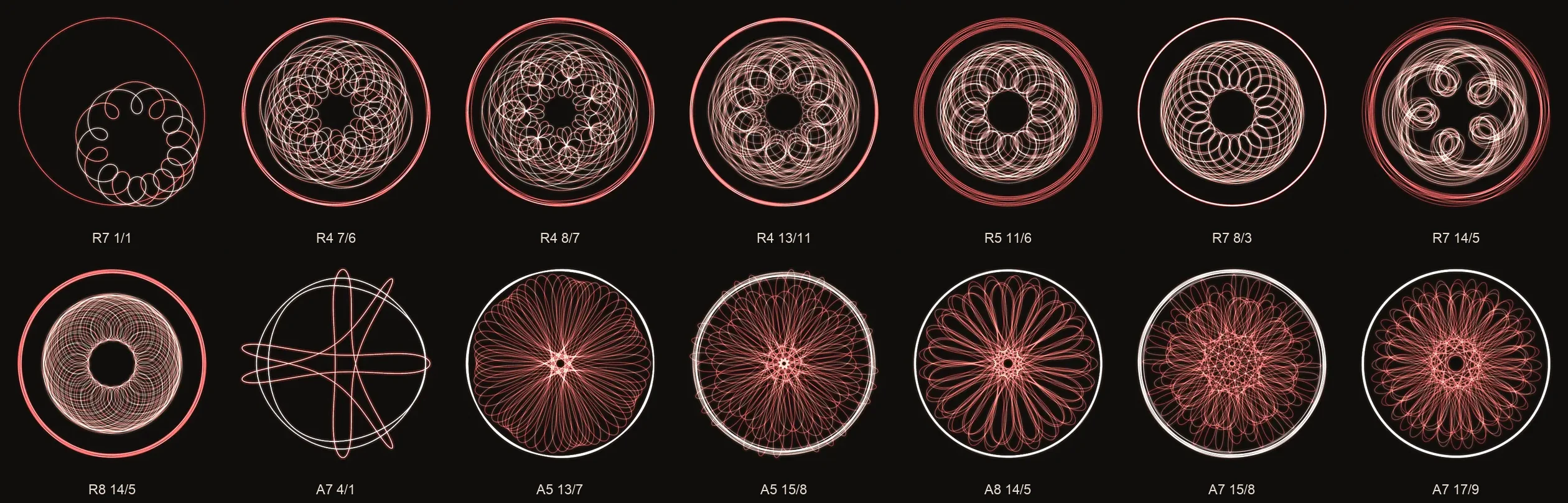
| Orbit | Branch | k | r/s | Period at E = −1 | T* | Word | Atlas closure |
|---|---|---|---|---|---|---|---|
| R7 1/1 | prograde (R) | 7 | 1/1 | 21.662650 | 1.3897 | (12)7 | 6e-30 |
| A7 4/1 | retrograde (A) | 7 | 4/1 | 26.848472 | 1.7223 | (12)7 | 5e-30 |
| R4 7/6 | prograde (R) | 4 | 7/6 | 103.239109 | 6.6228 | (12)24 | 5e-29 |
| R7 8/3 | prograde (R) | 7 | 8/3 | 104.850731 | 6.7262 | (12)21 | 8e-16 |
| A5 13/7 | retrograde (A) | 5 | 13/7 | 116.440793 | 7.4697 | (12)35 | 2e-29 |
| R4 8/7 | prograde (R) | 4 | 8/7 | 119.149079 | 7.6434 | (12)28 | 5e-29 |
| A8 14/5 | retrograde (A) | 8 | 14/5 | 130.632101 | 8.3801 | (12)40 | 4e-29 |
| A5 15/8 | retrograde (A) | 5 | 15/8 | 133.487456 | 8.5632 | (12)40 | 4e-29 |
| R5 11/6 | prograde (R) | 5 | 11/6 | 146.500125 | 9.3980 | (12)30 | 2e-29 |
| A7 15/8 | retrograde (A) | 7 | 15/8 | 168.739039 | 10.8246 | (12)56 | 3e-29 |
| R7 14/5 | prograde (R) | 7 | 14/5 | 179.834996 | 11.5364 | (12)35 | 2e-28 |
| R8 14/5 | prograde (R) | 8 | 14/5 | 190.201942 | 12.2015 | (12)40 | 9e-14 |
| A7 17/9 | retrograde (A) | 7 | 17/9 | 190.264002 | 12.2054 | (12)63 | 9e-29 |
| R4 13/11 | prograde (R) | 4 | 13/11 | 190.571224 | 12.2251 | (12)44 | 2e-28 |
T* = T|E|3/2/M5/2 with unit masses. The word is the orbit’s free-group class in the site’s syzygy letters: one binary loop is the letter pair 12.
What is new and what is not
No new topology. Every word is a power of the family’s one-letter word: in shape space each loop winds once around the same binary-collision puncture, and a collision-free continuation cannot change that. These are new orbits, with new periods, angular momenta, shapes and stability, not new topological families; the atlas’s own Broucke orbits already carry the words (12)n for n up to 7.
New to the catalogues checked. Each orbit was reduced to its relative loop (period, angular momentum and rotation per loop at fixed energy, the loop’s word and a rotation- and relabelling-invariant shape fingerprint) and compared with every atlas orbit with angular momentum, the Belgrade gallery’s 45 Hénon progenitors and 57 BHH satellites, the 598,996 relative orbits of Li & Liao’s 2020 supplement and the site’s published word index. Since a satellite family is a continuous curve, the catalogued satellites of the same k were also continued in angular momentum to see whether their branch reaches one of these orbits; none does. The closest catalogued loops are the parents themselves: three orbits sit beside a k-fold traversal of a Broucke orbit (R7 1/1 beside R7, A7 4/1 beside A14, R7 14/5 beside R9), with the same period to 10⁻⁴ but angular momentum 0.2 to 3 % apart and a different shape; the search confirmed that none of them returns after a k-th of its loop.
Prograde satellites are the larger part: the eight R-branch orbits lie on five satellite branches of a family branch that the literature describes as barely searched for satellites (Janković, Dmitrašinović and Šuvakov found “only a few” prograde satellites and publish none with data). The six retrograde ones lie on four branches away from the gallery’s satellites. Caveat: Janković, Dmitrašinović and Šuvakov (2020) show about a hundred retrograde satellites in figures, of which only the 57 of the gallery come with initial conditions; the six A-branch orbits cannot be excluded from the figure-only set.
Li & Liao’s unequal-mass tables. Li & Liao (2020) continued Broucke’s A orbits, Hénon’s orbits and the 58 known satellites into the plane of unequal masses (m₁, m₂ between 0.1 and 1, m₃ = 1); all are retrograde and all are relative orbits at their own rotation angle. Their tables therefore contain no equal-mass orbit and no prograde satellite, and none of their rows near equal masses (0.99, 0.99, 1) resembles any orbit here. The converse holds too: these fourteen satellites, continued into unequal masses, would enter the region their tables sample, and the retrograde ones may meet their satellite families there. The claim here is limited to equal masses and to closed (absolutely periodic) members.
Left out. The search’s other stable finds are rational closures of relative families that the catalogues already hold and were not added: the q = 8 members of Broucke’s A and R branches (one of them, θ = 3/8 on A, is within 5×10⁻⁵ of Hénon’s own orbit 35), and two further closures of Broucke and Boggs’s S122 satellite branch. The search also re-found Broucke and Boggs’s S4 and S122, as k = 3 satellites of A and R; S4 is the same orbit as Sheen’s loop-ended triangles, which the atlas now lists once, under S4.
One exception: A 2/3 at masses 0.3, 0.6, 1
The family also holds A 2/3 (0.3:0.6:1), included for its shape rather than its novelty. It is not a satellite and not a new relative orbit family: it is a member of Broucke’s A family itself, continued to the masses 0.3, 0.6 and 1 by a companion search (continuation in the masses at a fixed rational rotation) and closed where the pattern turns two thirds of a turn per loop, so that it repeats after three loops (period 3.580933 at E = −1, word (12)3). The atlas’s own tool closes it to 8×10⁻²⁸ and finds it linearly stable, as the search’s 128-bit monodromy did.
The retrograde BHH family at unequal masses is well known: Broucke and Boggs (1975) and Hadjidemetriou tabulated members, and Li & Liao (2020) continued Broucke’s and Hénon’s orbits over the whole mass plane, including this very mass point, where their supplement has 46 rows. None of those rows is this orbit (the nearest differs by 19 % in scaled period and 62 % in angular momentum), and theirs are relative orbits at their own rotation angles, not closed ones. So this is a new rational closure of a known family at a tabulated mass point, not a discovery; the atlas holds nothing else at these masses. The same search found several hundred such stable closures across the mass plane; this one alone was added.
How they were found and verified
Relative periodic orbits were computed at E = −1 as solutions of φT(z) = R(θ)z, continued by pseudo-arclength in angular momentum from Broucke A5 and R4 in both directions, while the transverse monodromy was followed for resonances, Krein collisions and folds. At 49 of the 62 resonances with k ≤ 8 a satellite branch was started along the resonant eigenvector and continued; rational rotations along it were solved exactly. Every orbit was refined at 128 bits, its closure re-measured at 192 bits (below 10⁻³⁰ for twelve of the fourteen), its word read from exact syzygy events, its primitivity checked, and its stability taken from the full monodromy at 128 bits. The atlas then recomputed each independently from the 60-digit state. Stability is planar linear stability, not a nonlinear or spatial statement.
The families themselves were validated on the way: the continuation recovers all 29 of the atlas’s Broucke A and R orbits as its rational members. Neither branch shows a period doubling or a pitchfork at equal masses.
Files
- Initial conditions: the fourteen states to 60 digits at E = −1, periods, words, closures and multipliers, and, listed separately, those of A 2/3 (0.3:0.6:1).
- The continuation data, verification logs and the catalogue comparison are available on request from info@threebodyorbits.com.